Topics / Left and right
The challenge
“The January 6 defendants deserved every day they got”
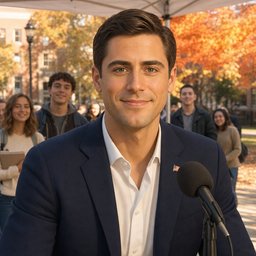
Nate · AI character. Not a real person.
Some did. Every day, every defendant? No. Start with the part nobody should dodge. About one hundred forty police officers were assaulted that day. Anyone who attacked a cop deserved to be prosecuted. But roughly fifteen hundred people were charged, and hundreds of them pleaded guilty to misdemeanors alone, like parading inside the building. Walking through a door someone else broke is a crime. It isn't the same crime as swinging a flagpole. In twenty twenty-four, in the Fischer case, the Supreme Court said prosecutors had stretched an obstruction law too far, a felony charged against hundreds of them. And the pardon power sits in Article Two for exactly this, mercy when punishment overshoots. Let me ask you this. Should a trespasser and a man who beat an officer carry the same label? Punish the violence. Fit the sentence to the man.
His strongest arguments
The violence was real and it was wrong. Start there, or nothing else you say about that day deserves a hearing.
The Justice Department reported that approximately 140 police officers were assaulted at the Capitol on January 6, 2021.
Proportionality means sorting people by what each one did. The Supreme Court itself found the government had over-read a felony statute it used in hundreds of these cases.
In Fischer v. United States, the Supreme Court held that the obstruction statute 18 U.S.C. 1512(c)(2), charged against hundreds of January 6 defendants, reaches only conduct that impairs records, documents, objects or other things used in an official proceeding.
Pretrial detention is supposed to turn on a specific danger from a specific person, not on the name of the event.
In United States v. Munchel, the D.C. Circuit held that pretrial detention requires an identified and articulable threat, and it distinguished defendants who assaulted police from those who only entered the Capitol.
The best comeback, and his answer
Challenger: They attacked the Capitol to stop the transfer of power. Juries convicted leaders of seditious conspiracy, and the blanket pardon freed people who beat police officers.
Nate: The men who beat officers earned their prosecutions, and I won't defend one swing. Juries did return seditious conspiracy verdicts against a small group of leaders. But most of the people charged were never accused of assaulting anyone, and justice sorts people by what each one did. Clemency for the nonviolent is what the pardon power is for. Mercy for a trespasser takes nothing away from the officers who got hurt.
What he grants the other side
About 140 officers were assaulted that day, and the people who attacked them deserved prosecution.
The lines
- “Punish the violence. Fit the sentence to the man.”
- “A trespass isn't an assault, and justice knows the difference.”
Sources
- U.S. Department of Justice, U.S. Attorney's Office for the District of Columbia, Capitol Breach Cases: periodic updates on the January 6 investigation and prosecutions (2024)
- Supreme Court of the United States, Fischer v. United States (2024)
- U.S. Court of Appeals for the District of Columbia Circuit, United States v. Munchel (2021)
- U.S. Constitution, Article II, Section 2 (1788)