Topics / Free speech
The challenge
“Controversial conservative speakers shouldn't be allowed on campus”
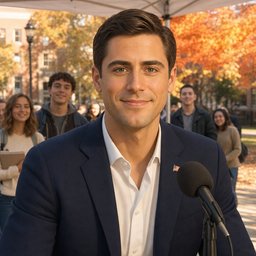
Nate · AI character. Not a real person.
Yes they should, and a university that says otherwise has forgotten what it's for. In Healy versus James, the Supreme Court said state colleges are not enclaves immune from the sweep of the First Amendment. The University of Chicago's free expression report says it's not the school's job to shield students from ideas they find offensive. And remember who started this fight. The Free Speech Movement began at Berkeley in nineteen sixty-four, with students on the left demanding the right to speak. You'll say some speakers make students feel unsafe. Hearing an argument you hate isn't danger. It's college. And cancelling an event because protesters threaten to shut it down just rewards the threat. Let me ask you this: who decides what's too controversial, and what happens when they decide it's you? A campus that can't handle a speaker isn't safer. It's just quieter.
His strongest arguments
Public universities are bound by the First Amendment. They can't shut out a view because officials or students find it offensive.
In Healy v. James (1972), the Supreme Court held that a state college could not deny recognition to a student group based on its views, stating that state colleges and universities are not enclaves immune from the sweep of the First Amendment.
A university exists to test ideas, and you can't test an idea you've never heard argued by somebody who believes it.
The University of Chicago's 2015 Report of the Committee on Freedom of Expression states that it is not the proper role of the university to shield individuals from ideas and opinions they find unwelcome, disagreeable, or even deeply offensive.
The answer to a bad speech is a better speech, a protest outside, or a tough question at the mic. Silencing the speaker teaches everybody that power beats persuasion.
In Whitney v. California (1927), Justice Brandeis wrote in his concurrence that the remedy to be applied is more speech, not enforced silence.
The best comeback, and his answer
Challenger: Some speakers spread ideas that make minority students feel unsafe, and a school has a duty to protect its students.
Nate: Protect students from threats, harassment and violence, every one of them, every time. But hearing an argument you reject is not being unsafe. Let a feeling veto a speaker and the loudest objector in the room decides what every other student is allowed to hear.
What he grants the other side
Private universities aren't bound by the First Amendment the way public ones are.
The lines
- “A campus that can't handle a speaker isn't safer. It's just quieter.”
- “If your side is right, you should want the debate, not the ban.”
Sources
- U.S. Supreme Court, Healy v. James, 408 U.S. 169 (1972)
- University of Chicago, Report of the Committee on Freedom of Expression (2015)
- U.S. Supreme Court, Whitney v. California, 274 U.S. 357 (Brandeis, J., concurring) (1927)
- University of California, Berkeley, The Free Speech Movement (1964)