Topics / Guns
The challenge
“The Second Amendment is only about militias”
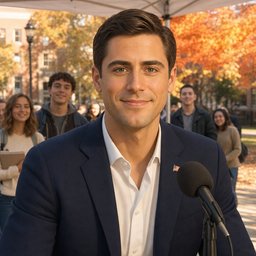
Nate · AI character. Not a real person.
No. The right belongs to the people, and the text says so. The First Amendment protects the right of the people to assemble, and nobody thinks that belongs to the National Guard. In District of Columbia versus Heller, the Supreme Court held the Second protects an individual right, and that the militia phrase announces a purpose without shrinking the right. And the militia was never a government army. The Militia Act of seventeen ninety-two enrolled ordinary able-bodied citizens. The founders had just thrown off a king, and they wanted free people armed so they'd never be helpless again. You'll say Heller was five to four. Close votes still count. Let me ask you this: if free speech belongs to you, why would the very next right belong to the government? The militia was the people. So was the right.
His strongest arguments
The right belongs to the people, and everywhere else in the Bill of Rights that phrase means individuals.
The First Amendment protects the right of the people to assemble, and the Fourth protects the right of the people to be secure in their persons, houses, papers and effects. Both are individual rights.
The Supreme Court has held flat out that the Second Amendment protects an individual right, and that it binds the states too.
District of Columbia v. Heller in 2008 held that the Second Amendment protects an individual right to keep and bear arms, and McDonald v. Chicago in 2010 applied that right to the states.
To the founders the militia wasn't a government army. It was ordinary citizens, and federal law still defines it that way.
The Militia Act of 1792 enrolled able-bodied male citizens of military age in the militia, and federal law today, 10 U.S.C. section 246, still recognizes an unorganized militia made up of able-bodied men of military age outside the National Guard.
The best comeback, and his answer
Challenger: Heller was a five to four decision that broke with how many courts read the amendment for most of the twentieth century, including the Supreme Court's 1939 decision in United States v. Miller, which focused on the militia connection.
Nate: Miller was about whether a short-barreled shotgun was the kind of weapon protected. It never held that only militia members have the right. Heller went back to the text and the founding-era sources, like Pennsylvania's seventeen seventy-six declaration that the people have a right to bear arms to defend themselves and the state.
What he grants the other side
For most of the twentieth century, many lower courts did read it the militia way.
The lines
- “The militia was the people. So was the right.”
- “The Second Amendment is the one that guards the First.”
Sources
- U.S. Constitution, Bill of Rights, First, Second and Fourth Amendments (1791)
- U.S. Supreme Court, District of Columbia v. Heller, 554 U.S. 570 (2008); McDonald v. City of Chicago, 561 U.S. 742 (2010) (2008)
- U.S. Congress, Militia Act of 1792; 10 U.S.C. section 246 (1792)
- Commonwealth of Pennsylvania, Pennsylvania Constitution of 1776, Declaration of Rights, Article XIII (1776)